Nashville Bombing Underscores Importance of Security Window Film Installation

The Christmas Day bombing in Nashville that severely damaged more than 40 buildings on historic Second Avenue and injured at least eight people was yet another reminder of the critical importance of protecting building windows in high traffic urban areas.

In this case, the city was fortunate in that the bomber did not intend to harm many people by setting off the device early in the morning on a holiday. Had the timing been different – evening on weekend night – the results could have been devasting.

As an example, we need to look no further than the two explosions that rocked Beirut, Lebanon on Aug. 4, 2020, causing more than 170 deaths and injuring more than 6,000. Property damage has been estimated at $10-$15 billion and more than 300,000 people are homeless.

Some of the deaths and unspecified thousands of the injured were victims of glass shards, as the force of the explosions shattered windows sending glass flying through the air in a large section of the city.

What triggered the main explosion has not yet been determined. But it has been confirmed that 2,750 tons of ammonium nitrate stored at the Beirut port for six years without proper safety measures was detonated. The blast is considered one of the most powerful non-nuclear explosions in history.

Coincidently, the same material – ammonium nitrate – was used in the 1995 terrorist attack on the Alfred P. Murrah Federal Building in Oklahoma City, Okla. That bombing caused 168 deaths and nearly 400 injuries. As in the Beirut blast, flying glass over a multi-block area was a significant culprit in the casualty total.

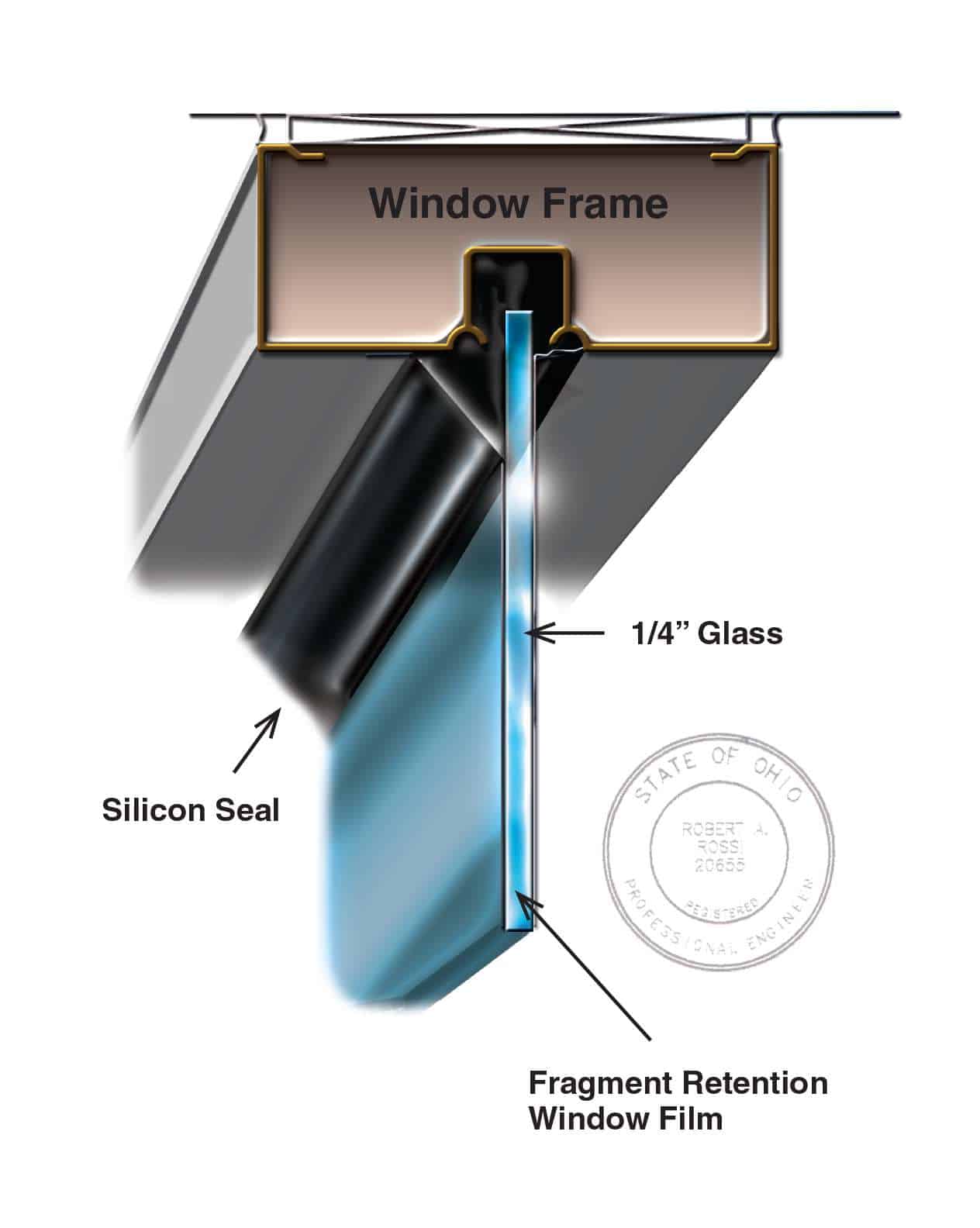
Following the Oklahoma City bombing, window film manufacturers who had been making solar control window film for years turned their efforts to producing a film that would hold glass windows in place during explosions and other unforeseen catastrophic events.

81b63735dcb60999ab40ebb4ff4cbf85.jpg

The result was creation of security window film, also known as fragment retention window film, shatter resistant window films and safety and security window films. These films quickly became popular with architects and engineers in the federal government and owners of large office buildings. Among the first high-profile buildings to have security window film installed were FBI headquarters in Washington, D.C. and the Pentagon.

A few years later, on Sept. 11, 2001, one of the four planes involved in the terrorist attacks, American Airlines Flight 77, crashed into the Pentagon. Loss of life and injuries were substantial in the location of the crash, but further casualties were prevented, according to government officials, in the peripheral areas of the building as the windows that had security window film installed held in place.

Since then, thousands of buildings around the country have had security window film installed to protect employees from unexpected terrorist attacks, unwanted intruders and catastrophic foul weather events. Among them are all the U.S. House of Representative and Library of Congress buildings, the U.S. Capitol, Departments of Energy, Transportation and EPA headquarters, Grand Central Terminal, O’Hare International Airport and Seattle-Tacoma International Airport, the United Nations, Philadelphia and Denver mints and the Willis [former Sears] Tower.

However, even the installation of security window film on a building doesn’t guarantee it will protect the windows – unless it has a proper attachment system. This proved true at the insurrection at the U.S. Capitol on Jan. 6, when rioters breached the building through windows and doors. The windows had security window film installed on them but not the suggested wet glaze attachment system. Thus, the rioters were able to dislodge the windows from the frame and enter the building.

If you are considering having security window film installed on your building windows, you’ll want to hire an experienced installation company. It takes a specific, hard-to-find expertise to properly install security window films for them to be effective as well as using the proper attachment system. The Christmas Day Nashville bombing is just another in a long list of reminders of the importance of protecting your building windows.
Source Url :- https://site-2112253-4331-9832.mystrikingly.com/blog/nashville-bombing-underscores-importance-of-security-window-film-installation

U.S. Capitol Windows, Missing Key Security Feature, Give Way During Mob Attack

When the mob that entered the U.S. Capitol on Jan. 6 to protest the result of the presidential election they did so, in part, by entering through the building’s windows.

Many of the windows were protected by a security window film that was installed after the terrorist attacks on 9/11. The fragment retention window film, which also was installed on all the House of Representative and Library of Congress buildings, is effective in holding glass in place during explosions and attempts to break the glass by building intruders.

However, a second component of the window safety system, the installation of a wet glaze attachment system, was not in place at the Capitol building. As a result, while the glass withstood attempts by the mob to shatter it, the window frames were dislodged, allowing the intruders to enter the Capitol. Had the wet glaze attachment system been in place it would have been far more difficult for the mob to enter the Capitol building.

For years, windows in numerous government buildings in Washington and elsewhere in the country have been protected by security window film installation with a wet glaze attachment system.

More recently, after a series of intrusions and attacks in schools around the country, many school systems have had security window film with a wet glaze attachment system installed on their first floor windows and doorways to help keep out armed intruders.

servicepage8img696x283.jpg

It was following the Oklahoma City bombing of the Alfred P. Murrah Federal Building in 1995, during which many of the dead and injured were the result of flying glass shards, that window film manufacturers turned their efforts to producing a film that would hold the glass in place during explosions and other unforeseen catastrophic events.

The result was creation of security window film, also known as fragment retention window film, shatter resistant window films and safety and security window films. These films quickly became popular with architects and engineers in the federal government and owners of large office buildings.

In the aftermath of the attack on the U.S. Capitol, there are warnings of additional, possibly violent events in Washington and elsewhere in the country. And once again government officials and building owners in urban areas will be looking at ways to protect their buildings and their employees.

Certainly, the installation of security window film with a wet glaze attachment system is one proven way to protect a building. The best way to explore this option is to find a reputable and experienced security window film installation company with considerable experience and expertise in the installation of fragment retention film as well as wet glaze attachment systems.

Source Url :- http://thetokenclock.com/2021/02/19/u-s-capitol-windows-missing-key-security-feature-give-way-during-mob-attack/

Radio Frequency Shielding Window Films Protect Building Tenants Against Hackers

The recent news of an unprecedented cyber attack on the U.S. federal government is a reminder of how diligent both the government and private sector have to be in staying ahead of increasingly daring cyber hackers and thieves.

It is clear the need for protection against hackers has increased dramatically in recent years as the sophistication of information theft has reached new levels. One novel method of information theft by cyber thieves is by using optical or electronic devices to penetrate office windows in high security government and commercial buildings.

Specifically, the hackers are stealing secure and classified information from cell phones and computer screens through transparent window glass. Such theft can have catastrophic results if sensitive and high-security information gets in the wrong hands. The economic and national security damage is almost immeasurable from such cyber theft.

As a result, window film manufacturers have recently developed a new security film, called Radio Frequency Shielding Window Films. These films, known as RF films, are installed on the interior of glass windows in office buildings in areas of high security and where vital information is at risk of being compromised.

The film is comprised of specialized properties that block any and all optical and electronic devices, thus thwarting any attempt by cyber hackers to steal sensitive information from government or the private sector.

When seeking out installers of RF films it is best to make sure the company has the right expertise and experience as the product is relatively new and the number of experienced installers comprise a short list.

crystalcitybuilding.jpg

Commercial Window Shield if one of the country’s most experienced installers of RF window film. In particular, the company has a close working relationship with many architects, general contractors, building owners and building management companies.

The company, most known for its installation of security and solar control window films, has developed a particular expertise in the installation of RF window films. Government agencies and corporations are now considering having RF film installed in certain high-security offices while also having security film installed to keep windows in place during catastrophic events and solar control film for sun control and energy savings.

Commercial Window Shield’s years of experience in installing a variety of window films in large office buildings, has the ability to develop a practical RF films installation schedule so as not to disrupt the office environment. This usually means installing the RF film on office glass windows in the evening or at night.

Once you have RF film installed on the windows of offices you want to be secured will be able to have complete confidence hackers will not be able to steal information from cell phones or computer or tablet screens.

Source Url :- https://timebusinessnews.com/radio-frequency-shielding-window-films-protect-building-tenants-against-hackers/

Uptick in Hurricanes, Tornadoes Threatening Lives As Building Windows Shatter

Lives As Building Windows Shatter

When Hurricane Laura struck the Louisiana-Texas coastline in late August, the property damage was devastating. In particular, the town of Lake Charles was hit hard. The symbol for the hurricane’s power and destruction was the town’s 22-story Capitol One building. The building had suffered serious damage during Hurricane Rita in 2005. And, now, 15 years later it was severely damaged again, with about half the building’s windows blown out. Fortunately, the building was empty and there were no injuries from the flying glass.

  Lake Charles’ Mayor Nic Hunter told a local TV station that the building “looks like Swiss cheese.”

  Unfortunately, Hurricane Laura appears not to be a fluke storm that happens once a decade or so, as was the case previously. Already in 2020 there have been 23 named storms, the seconds most on record. Moving forward, weather forecasters and scientists are predicting more volatile hurricanes, tornadoes and other foul weather events in the coming years related to climate changes.

  What this means for office building owners is the need to protect their buildings, including making sure their glass is secured so it doesn’t shatter, causing serious injuries and death to building occupants or people on the street below.

The best way to protect windows in office buildings in parts of the country threatened by hurricanes, tornadoes and other foul weather events is to install security window film, also known as shatter resistant window film and fragment retention window film.

  These films are most often installed to the inside of windows – sometimes with a wet glaze attachment system. The result is the glass will hold firm during hurricanes, tornadoes or any catastrophic event – saving lives and money for the building owner.

  With the uptick in significant storms in recent years there are many examples of buildings have their windows blown out.  As a result, glass protection has become a high-priority for building owners.

  Building owners, property managers, architects and general contractors seeking the best way to protect windows in their building need to locate an experienced security window film installer with a particular expertise in shatter resistant window films.

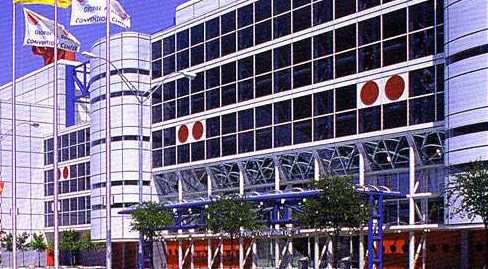
  Commercial Window Shield is one of the country’s leading installers of security window films. Two of its most prominent projects in hurricane belts were the installation of security film on the George R. Brown Convention Center in Houston and the Shands Jacksonville [Fla.] Medical Center.

Cities Move to Protect Birds in Flyway Zones with Bird Safety Window Film Installation Legislation

The relatively recent interest in anti-bird strike window film received a significant boost with the December, 2019, passing by the New York City Council of legislation requiring bird friendly glass in buildings throughout the city.

The law passed after an intense bird safety campaign by local and national conservation groups and with the support of a number of influential building architects.

The city is in a major northeast bird migration route known as the Atlantic Flyway. As a result of that and the huge number of high-rise buildings in the city with glass facades, between 90,000 and 230,000 birds die annually from flying into the buildings.

New York isn’t the only city with this problem. There are five major bird flyways in North America, stretching from the West Coast to the East Coast. A number of major cities with numerous high-rise buildings are located in these bird migration zones. Chicago, Houston and Dallas are considered the most dangerous cities for bird migrations. In total, it’s estimated that around 600 million birds die annually from striking buildings and other structures.

As a result, various forms of bird safe building standards or legislation has been adopted in the state of Minnesota; several California cities, including San Francisco and Oakland; and Toronto. San Francisco was the first city to pass bird safety legislation in 2011, although it was not a binding law. Several members of Congress have introduced legislation seeking bird-safe requirements in new federal buildings.

The issue with birds and office building glass involves location, light conditions, and time of day. Building glass and windows can appear highly reflective or completely transparent. By appearing similar to open sky, trees, and vegetation, it causes birds to mistake the space as a safe place to fly.

Most birds’ first encounters with glass are fatal as they collide with it at full flight speed. The uniqueness of bird vision is a contributing factor to this problem. While humans have eyes in the front of their heads and good depth perception, most birds’ eyes are at the sides of their heads. Thus, they have little depth perception beyond the range of their bills but extensive fields of view to the side and behind. They judge their flight speed by the passing of objects to their sides, so their focus in flight is not necessarily ahead.

So rather than designing buildings using less glass, which will not be happening, birds can be protected by “marking” the glass in some way so they perceive the windows as barriers and avoid them.One easy and cost-effective way to do this is to install anti-bird strike window film on all glass that is located in bird flyway zones. These films usually have horizonal or vertical patterns that make the glass visible to birds

In New York, for instance, the law requires 90 percent of the building envelope for the first 75 feet of a new building – or any building undergoing major alterations – to be constructed of bird-friendly materials meeting a specified design standard intended to decrease bird strikes.

The law also requires the installation of the bird-friendly materials where an exterior wall envelope is adjacent to a green roof system and on certain installations that create hazards for birds, such as glass awnings, handrails, windbreak panels, acoustic barriers, and parallel glass panels.

The law relates to new construction but there is an important clause requiring architects and builders to include bird protection during any building renovation project. In this case, anti-bird strike film installation is the perfect solution to the problem.

The American Bird Conservancy, which has a glass collisions program, was a major player in advising New York’s city council on the legislation. The group also has worked closely with architecture firms around the country to get them on board with the bird safety effort in their building designs.

The Jacob Javits Convention Center in New York is a significant success story in the quest to improve building glass safety for birds. Once considered the deadliest building in New York for birds because of the huge amounts of reflective glass in the building’s design, a building renovation project completed in 2014 that included fritted, translucent glass panels reduced bird deaths by 90 percent.

If you own or manage a building in a bird flyway zone and are being confronted with the unfortunate spectacle of birds crashing into your windows, you’ll want to contact a company experienced in the installation of bird safety window film. Commercial Window shield is one of the country’s pioneers in the installation of anti-bird strike safety window film.

https://www.commercialwindowshield.com/

Beirut Tragedy Underscores Importance of Security Window film Installation

The second of two explosions that rocked Beirut, Lebanon on Aug. 4, 2020, caused more than 170 deaths to date and injured more than 6,000. Property damage has been estimated at $10-$15 billion and more than 300,000 people are homeless.

Some of the deaths and unspecified thousands of the injured were victims of glass shards, as the force of the explosions shattered windows sending glass flying through the air in a large section of the city.

What triggered the main explosion has not yet been determined. But it has been confirmed that 2,750 tons of ammonium nitrate stored at the Beirut port for six years without proper safety measures was detonated. The blast is considered one of the most powerful non-nuclear explosions in history.

Coincidently, the same material – ammonium nitrate – was used in the 1995 terrorist attack on the Alfred P. Murrah Federal Building in Oklahoma City, Okla. That bombing caused 168 deaths and nearly 400 injuries. As in the Beirut blast, flying glass over a multi-block area was a significant culprit in the casualty total.

Following the Oklahoma City bombing, window film manufacturers who had been making solar control window film for years turned their efforts to producing a film that would hold glass windows in place during explosions and other unforeseen catastrophic events.

The result was creation of security window film, also known as fragment retention window film and shatter resistant window films. These films quickly became popular with architects and engineers in the federal government and owners of large office buildings. Among the first high-profile buildings to have security window film installed were FBI headquarters in Washington, D.C. and the Pentagon.

A few years later, on Sept. 11, 2001, one of the four planes involved in the terrorist attacks, American Airlines Flight 77, crashed into the Pentagon. Loss of life and injuries were substantial in the location of the crash, but further casualties were prevented, according to government officials, in the peripheral areas of the building as the windows that had security window film installed held in place.

Since then, thousands of buildings around the country have had security window film installed to protect employees from unexpected terrorist attacks, unwanted intruders and catastrophic foul weather events. Among them are all the U.S. House of Representative and Library of Congress buildings, the U.S. Capitol, Departments of Energy, Transportation and EPA headquarters, Grand Central Terminal, O’Hare International Airport and Seattle-Tacoma International Airport, the United Nations, Philadelphia and Denver mints and the Willis [former Sears] Tower.

If you are considering having security window film installed on your building windows, you’ll want to hire an experienced installation company. The installation process can be complex and does require specific expertise.Commercial Window Shield is one of the country’s most experienced installers of security window films and is a pioneer in the field dating back almost 40 years.

Solar Control and Security Window Films Offer Energy Savings and Glass Protection

Solar control window film have been a poplar choice for architects, engineers and building owners aiming for increased comfort for office employees and reduced utility bills.

Security window films, developed in the late 90s after the Oklahoma City bombing in which numerous casualties and injuries were connected to flying glass shards from windows blown out by the blast.

Which film is right for your building depends on which issue is of greater concern. Let’s look at each situation:

Solar Control Window Film

Everyone has sat next to a window in an office or other environment in which the sun’s rays penetrate the glass causing an uncomfortable heat that can’t be controlled unless you move elsewhere.

Not only do penetrating sun rays make for an uncomfortable work environment, the heat causes havoc with a building’s HVAC system, causing utility bills to spike. Also, when the HVAC system is out of whack it can be hot on one side of the office, near the windows but unusually cold on the other side, making it uncomfortable for people working there.

The best way to fix the problem without eliminating the window view taking away the view is to install heat-reducing window films. These films, known as solar or sun control window films, are coated with materials that reflect away the sun’s heat. They also reduce the brightness of the sun and virtually eliminate ultraviolet light. But, the view outside remains.

And, just as important, heat reducing window films allow the building’s HVAC system to work normally, reducing utility bills. Over time, the cost savings from these reduced utility bills pay for the installation costs of the film, making it a wise investment.

Security Window Films

Security window films, also known as fragment retention window films and shatter resistant window films, are designed to increase the shatter resistance of glass during catastrophic blasts such as terrorist attacks or natural gas explosions, and natural weather disasters, such as hurricanes and tornadoes.

As the threat of terrorism and the number of severe weather events have increased in recent years, the demand for fragment retention window film has increased. This has been particularly true in buildings occupied by the federal government, schools and key buildings in the country’s hurricane and tornado belts.

Solar Control/Security Window Film

There are occasions when building engineers or owners want their building windows to be both secure and energy efficient. This calls for the installation of a security window film with solar control capabilities. This is a relatively recent film developed as the demand for a dual window film has increased.

If you are searching for a company to install solar control or security window film you want to look for experience and expertise. Commercial Window Shield is one of the most experienced installers of both fragment retention and solar control window films. The company also has considerable experienced installing the hybrid, security/solar control window films.

Security Window Film Will Protect Your Building During Violent Civil Unrest

The protests in late May over the death of George Floyd in Minneapolis, brought between 15 and 26 million people into the streets of hundreds of American cities and towns. It’s considered to be the largest mass demonstration in U.S. history. While the overwhelming majority of the protestors were peaceful, there were violent elements among them who caused significant damage to thousands of buildings along with looting millions of dollars of merchandise.

Some of the figures are staggering:

$500 million – Estimated damage in Minneapolis-St. Paul to more than 500 buildings

$10-$15 million – Estimated damage to buildings in Atlanta’s Buckhead neighborhood

135 – Number of buildings damaged in Chicago’s central business district

14,000 – Number of looters arrested nationwide

gif;base64,R0lGODlhAQABAAAAACH5BAEKAAEALAAAAAABAAEAAAICTAEAOw==

While the protests have subsided, building owners are now faced with the task of repairing their damaged buildings and replacing all their damaged property and stolen inventory. The cost would be staggering in normal times but even more so now with the economic impact of COVID-19.

Once the damage is repaired building owners will be asking themselves: What can I do to protect my building in the future should similar civil unrest resume?

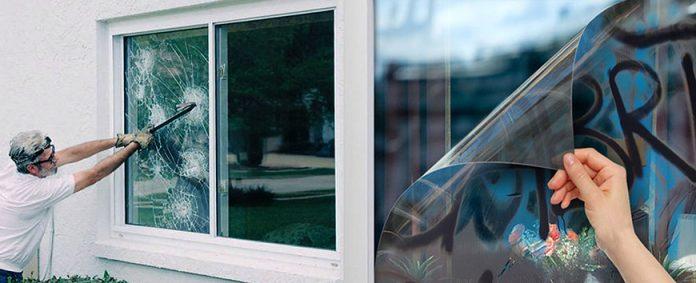
One answer is to install fragment retention film on your windows. Also known as shatter resistant window films or security window films, these films are designed to increase the shatter resistance of glass during catastrophic events – such as riots, terrorist attacks, explosions and foul weather.

Safety and security windows films range in thickness from 4 to 21 mils, which is

thicker than typical window films. The films are almost always installed on the interiorof the windows and doors. They require a heavier, more aggressive adhesive system.

They can be anchored to the window frame with either a wet glaze or mechanical system. The type of installation system that is used can depend on the type of glass and windowframe that’s being protected. Generally, more sophisticated attachment systems arerequired for the thicker security window films.

The combination of security film and proper installation means that if the glass breaks it will hold in place. The significance of this during violent protests is it will keep looters out of your building because it’s very difficult and time-consuming to penetrate windows secured with shatter resistant window film. If you factor the cost of security film installation versus the cost of replacing your building inventory and repairing the damage, security window film is a smart investment.

If you are considering having security window film installed on your building windows, you’ll want to hire an experienced installation company. The installation process can be complex and does require specific expertise. Commercial Window Shield is one of the country’s most experienced installers of fragment retention window films and is a pioneer in the field dating back more than 30 years.

Solar Control Window Films Improve Building Comfort and Reduce Utility Bills

Everyone has sat next to a window in an office or other environment in which the sun’s rays penetrate the glass causing an uncomfortable heat that can’t be controlled unless you move elsewhere.

This can even happen in the dead of winter in a cold climate where you’d think the sun rays would feel good. But the searing heat gain coupled with heat from the building’s HVAC system can make it intolerable to sit at a desk near a window.

Not only do penetrating sun rays make for an uncomfortable work environment, the heat causes havoc with a building’s HVAC system, spiking utility bills. Also, with the HVAC system is out of whack, while it might be hot on one side of the office, it can be unusually cold on the other side, making it uncomfortable for people working there as well. 

Commercial Window Film Installation Company

One remedy is to install blinds or shades. That can help alleviate the sun problem but it means the view out the window has been eliminated which can turn an office building into a cave-like atmosphere. So, the only way to fix the problem without taking away the view is to install heat-reducing window films. These films, known as solar control or sun control window films, are coated with materials that reflect away the sun’s heat. They also reduce the brightness of the sun and virtually eliminate ultraviolet light. But the view outside remains so you are getting the best of both worlds.

There are two types of heat reducing window films:

 interior and exterior.

Exterior filmswhich are not common, are effective on sloped or unusually shaped glass and onatriums. You often see this film on museums and buildings with uniquely designedentranceways.

Interior films are more widely used to correct sun control issues. They are clear anddon’t impact outside viewing.  They produce immediate relief to building occupantssitting near exposed glass, as solar heat gain is no longer an issue. 

And, just as important, heat reducing window films allow the building’s HVAC system to work normally, reducing utility bills. Over time, the cost savings from these reduced utility bills can pay for the installation costs of the film, making it a wise investment.

If you are considering having solar control film installed on your building windows you’ll want to hire an experienced installation company. The installation process can be complex and does require specific expertise. Commercial Window Shield is one of the country’s most experienced installers of solar control window films and is a pioneer in the field dating back almost 40 years.

Experts Touting Face Shields Over Masksas Best Protection Against COVID-19

As the use of a face cover has become common place across the United States in the wake of COVID-19, the question is: Which one works best, the mask or a face shield.

Initially, masks were considered the preferred way to protect someone from both spreading the virus and protecting themselves. This is something we’ve seen doctors, nurses, dentists and other health care providers do for years.

However, the masks weren’t intended to be protection against viruses like COVID-19. So, although medical experts believe they are mostly effective there is no solid data.  Additionally, many different companies are making masks and the quality and effectiveness level of them vary. More troubling, homemade versions of the mask might not be good enough and give people a false sense of protection.

Face shields is a viable alternative to masks are increasingly being championed by public health professionals. If made properly, with the right headband, the shields are considerably more comfortable than masks. They also make breathing much easier. Face shields cover the entire face, are made of a clear plastic for excellent visibility and – significantly – do not fog up eye glasses like a mask does.

While masks have to be continually washed, face shields can be easily cleaned with disinfectant wipes or a mild soap and water.

People who are deaf and have serious hearing issues can be understood when they are wearing a face shield but not when they are wearing a mask.

Face shields are more economical because you only need to buy one. You will need multiple masks as you have to cycle them through the cleaning process almost on a daily basis.

Medical personnel have been wearing both the mask and the face shield for ultimate protection as they are on the front lines. People who work in retail establishments – especially salons, day spas and restaurants – are finding that the face shield is preferable to the mask. They also feel more confident wearing the face shield.

One of the top face shields in the U.S. is the Safe-Gard, made by Madico, a leading manufacturer of coated and laminated window films.

The Safe-Gard Face Shield includes a comfortable, water-resistant, closed-cell, foam front with adjustable head fasteners and Velcro® closure to ensure a good seal.

Made in the United States, the Safe-Gard Face Shield is ANSI Z787.1-2015 certified against droplet hazards, verified through independent laboratory testing.

Commercial Window Shield of Taylors, S.C., is a leading distributor of the Madico Safe-Gard Face Shield.

For more information contact Adam Staley, Commercial Window Shield, at adam@commercialwindowshield.com or [419] 215-9469.

Design a site like this with WordPress.com
Get started